a game discovery system designed to reduce emotional risk for players navigating unsafe, exclusionary, or exhausting gaming spaces.
impact: designed a values-aware game discovery system that layers accessibility, representation, trigger warnings, and community safety signals onto traditional game metadata - helping players evaluate not just what a game is, but how it may feel to actually play.
my role
UX/UI Designer, UX Researcher
end-to-end systems ownership (solo)
timeline
april - june 2025
scope
user research, interface design, design systems
↦ “It's dangerous to go alone."
-The Legend of Zelda
↦ the why
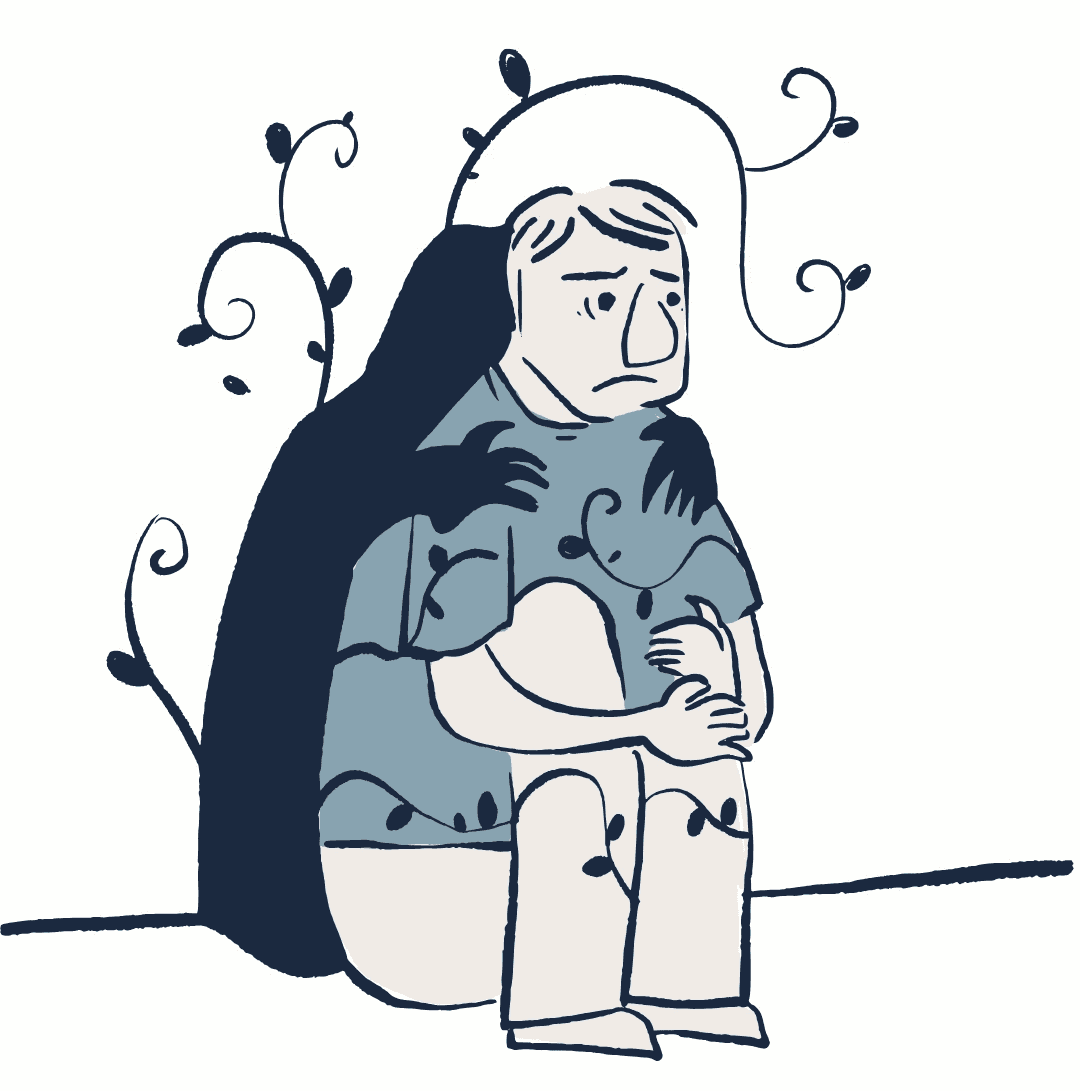
game discovery is often treated like a neutral browsing experience. but in reality, it is anything but neutral.
For many players, especially those from marginalized communities, choosing a game can involve a quiet but very real form of risk assessment.
Will this game feel welcoming?
Will its community be hostile?
Will it include accessibility support?
Will it handle identity, violence, or trauma in ways that feel manageable …. or not?
Most existing platforms still prioritize popularity, performance metrics, and aggregate scores. What they tend to miss are the factors that make a game feel emotionally safe, socially tolerable, or even worth attempting in the first place.
Joystick came from a different premise: discovery systems should reduce risk, not externalize it onto the player.
↦ the research
understanding harm, trust, and decision fatigue in game discovery
My research showed that discovery decisions are shaped less by preference than by risk avoidance. For many players, especially those with prior experiences of harm, choosing a game involves assessing potential emotional and social risk with limited information.
So, rather than feeling empowered by choice, players often experience uncertainty, fatigue, and distrust toward existing platforms.
Key research insights:
76% of online multiplayer users have experienced harassment (ADL, 2024).
Players want tools that feel personal and contextual, not generic or algorithmic.
Accessibility and safety are foundational requirements, not optional enhancements.
These insights were informed by personas, empathy mapping, and usability testing across four prototypes.
designing for players who carry risk into discovery
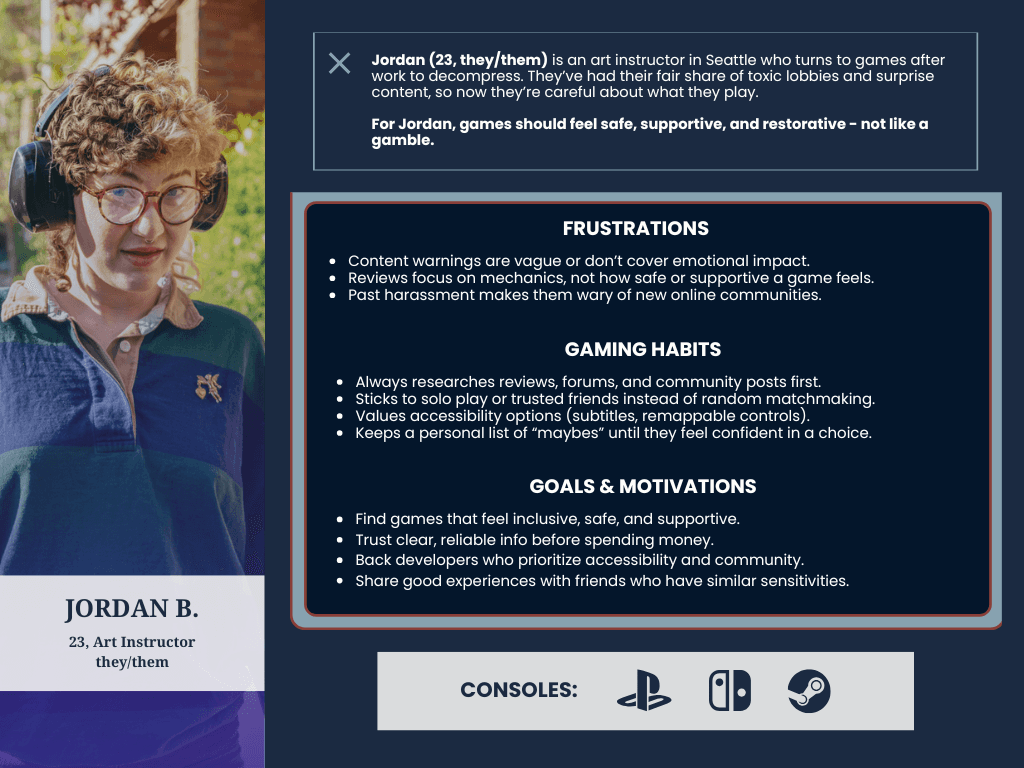
Persona: Jordan B. (they/them)
Jordan uses games as a way to decompress after emotionally demanding workdays. Past experiences with harassment have made them cautious, requiring extra effort to assess whether a game will feel safe, inclusive, and accessible.
↦ the insights
through a competitive analysis, I found that across platforms, the failure mode was consistent: discovery tools surface volume without context, leaving players to infer safety, tone, and representation on their own
Common Sense Media offers thoughtful guidance, but is primarily child-focused and limited in scope.
Metacritic aggregates reviews without moderation, emotional framing, or safety signals.
MobyGames provides detailed metadata but lacks usable, human-centered interpretation.
IGDB prioritizes developer needs over player understanding.
For many players, especially those with prior experiences of harm, choosing a game is not simply about taste. It is about trying to predict emotional cost with incomplete information.
A few of these key findings shaped the project most:
Players needed context, not just more data
Across platforms, there is no shortage of information. What is missing is usable interpretation. Players wanted tools that helped them understand emotional tone, community norms, representation, and accessibility in a way that felt readable and relevant.

Accessibility and safety were not “bonus” filters
They functioned more like baseline requirements. Players did not see these signals as niche enhancements. They saw them as foundational to whether a game was even worth considering.
Discovery tools often shifted the burden back onto the user
Competitive analysis revealed the same pattern over and over: platforms offered volume, but not clarity. Players still had to infer whether a space would be welcoming, hostile, or exhausting.

Trust had to be designed very carefully
A system like this could easily become too heavy-handed, too clinical, or too visually loud. Users responded best to designs that felt calm, affirming, and transparent without feeling overly curated or emotionally manipulative.
↦ the design decisions
joystick became much stronger once I stopped thinking about it as “better filtering” and started treating it as a trust-building system.
1. I designed for emotional safety, not just information retrieval
Traditional discovery systems optimize for search and recommendation. I wanted Joystick to also support emotional preparation and informed consent.
Trade-off: The system had to communicate more nuanced signals without making the experience feel dense or intimidating.
2. I surfaced identity-aware criteria without forcing self-disclosure
Joystick includes signals around accessibility, representation, trigger warnings, and toxicity, but does not require users to explain or declare their identity in order to benefit from those filters.
Trade-off: Less personalization upfront, but more privacy, flexibility, and emotional safety.
3. I used warm, calm visual language instead of competitive or performance-heavy aesthetics
Many gaming interfaces lean loud, intense, or overstimulating. I intentionally moved in the opposite direction to communicate trust, softness, and readability.
Trade-off: A less “traditional gaming” aesthetic, but a much stronger emotional fit for the problem space.
4. I treated contribution as care, not labor
Rather than designing around extraction or endless content generation, I explored how users could contribute feedback through affirming, values-based prompts and badges.
Trade-off: Slower contribution volume, but a stronger sense of meaning and respect.
5. I broke the system into four prototypes across the discovery journey
Instead of trying to solve everything in one flow, I tested onboarding, tutorial, browsing/filtering, and contribution as separate but connected moments.
Trade-off: More moving parts in the process, but better insight into where trust was gained or lost across the full experience.
↦ the refinement
one of the biggest tensions in this project was how to design for safety without increasing cognitive load.
At first, there was a risk of over-explaining everything - too many labels, too much guidance, too much protective language. But that would have created its own kind of friction. A platform meant to reduce emotional burden should not feel emotionally heavy to use.
Usability testing surfaced both strengths and friction points, directly shaping refinements across onboarding, navigation, and contribution flows.
Iterative testing revealed both strengths and points of friction, shaping subsequent refinements across onboarding, navigation, and contribution flows.
So the work became less about adding signals everywhere and more about deciding where they mattered most, how they should be framed, and how much the user should be asked to process at once.
That led to a more restrained system: clearer onboarding, more skippable education, better filter visibility, more context around badges, and calmer contribution flows.
↦ the solution
i designed Joystick as a discovery system that supports safer, more values-aligned gameplay decisions from first use through long-term contribution.
The final concept was shaped through four connected prototypes, each focused on a different moment in the user journey.
prototype 1: onboarding
The onboarding flow was redesigned to reduce the emotional cost of entry.
Rather than opening with highly personal or identity-heavy questions, the experience begins with familiar topics like favorite games and genre preferences. This creates a gentler entry point while still building toward more meaningful customization over time.
I also introduced:
skip options to preserve user control
improved button size, contrast, and readability
a more invitational tone that felt supportive rather than interrogative
What this improves
lowers pressure during first-time use
builds trust without forcing vulnerability too early
makes the platform feel more approachable from the start
prototype 2: tutorial
The tutorial was designed to guide without overwhelming.
Because many users may arrive with prior experiences of harassment, exclusion, or fatigue, I wanted the instructional layer to feel lightweight, optional, and easy to revisit. Rather than treating guidance like a mandatory training sequence, I framed it as a soft orientation.
I refined:
badge explanations through separate, clearer screens
explicit “tap to continue” prompts
the ability to skip or revisit tutorial content
Sage’s role as a gentle guide rather than a dominant mascot
What this improves
reduces onboarding fatigue
gives users more control over pace and depth
makes the system’s values legible without overselling them
prototype 3: browsing and filtering
This part of the system focused on helping users search and explore without leaving important emotional or identity-related criteria buried.
Alongside genre and platform, users could browse with filters related to:
accessibility support
representation markers
trigger warnings
community safety signals
Key refinements included:
changing “All PS5 Titles” to “Filtered Results” for clarity
adding visible filter states and dynamic sorting
increasing checkbox and CTA size
reorganizing tag categories to make browsing feel more intuitive
What this improves
makes hidden risk factors more visible
supports both exploratory and search-driven behavior
reduces the need for off-platform research and guesswork
prototype 4: contribution and persuasion
Contribution was framed as a form of care, not a demand for free labor.
Rather than relying on competitive gamification, I explored values-based badges like “Access Ally” that affirm the impact of contributing useful context for other players. The goal was to encourage participation in a way that felt respectful, emotionally coherent, and aligned with the platform’s purpose.
Refinements included:
linking feedback more clearly to specific games
clarifying the purpose of each badge
standardizing validation language across flows
making contribution feel contextual rather than bolted on
What this improves
makes participation feel meaningful instead of extractive
supports long-term trust and community usefulness
reinforces the platform’s values through action, not just copy
↦ the visual system
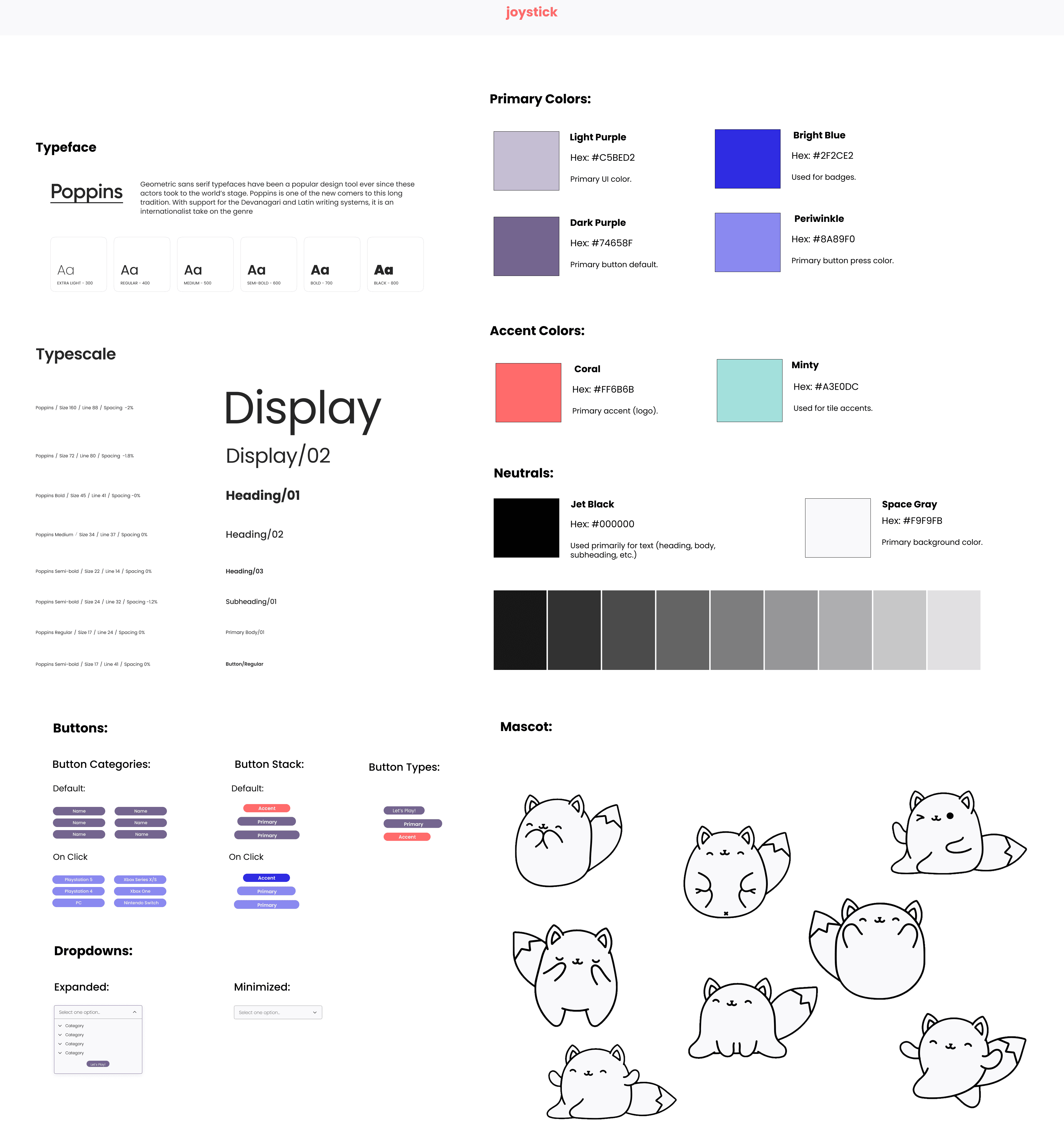
the visual system was designed to signal safety, clarity, and emotional legibility - not performance.
That meant:
lavender and teal as the emotional anchor of the palette
restrained supporting colors for familiarity and balance
accessible typography with soft but readable hierarchy
icon and tag systems that made meaning scannable
Sage (the mascot) as a quiet guide, not a mascot that hijacks attention
I treated visual and tonal decisions as trust signals, not decoration. The interface needed to feel calm enough to lower defenses, but clear enough to support real decision-making.
↦ the impact
joystick was ultimately about reducing the invisible labor players often carry into discovery. even without a launched product, the design impact became clear in a few important ways.
For players
made emotional and identity-related considerations more visible during discovery
reduced the need to piece together safety information across fragmented sources
supported more informed, lower-risk gameplay decisions
For the product concept
tested four connected prototypes across the full discovery journey
identified where trust was gained or lost across onboarding, navigation, and contribution
clarified how emotional design can support informed consent without creating overload
Through usability testing
validated the importance of warmth, clarity, and gradual value communication
surfaced key accessibility and interaction issues that shaped final refinements
strengthened the case for calmer, more human-centered gaming interfaces overall
↦ the reflection
this project taught me that designing for emotional safety requires a lot of restraint.
It is not about layering on endless reassurance or trying to solve every harm through interface language. It is about making thoughtful decisions around what to surface, when to surface it, and how to preserve user autonomy throughout.
It also reminded me that inclusion is often built through small choices: opt-outs, readable defaults, plain language, clear filter states, and moments of affirmation that do not ask people to prove why they need them.
If I continued the project, I would focus next on:
testing with more disabled, neurodivergent, queer, and caregiving players
refining how community toxicity signals are gathered and displayed
expanding profile flexibility without increasing self-disclosure pressure
exploring how trust evolves over longer-term use, not just first-time onboarding