A research-driven product concept that reframes household food waste as a behavioral and systems-design problem - balancing sustainability goals with everyday constraints like time, memory, and budget.
impact: designed a mobile concept that helps households track inventory, act before food expires, and make more informed meal decisions - reframing sustainability as something supported by better everyday systems rather than better personal virtue
my role
UX/UI Designer, UX Researcher, UX Writer
timeline
september - december 2024
tools
Figma, FigJam, Canva, Google Suite
↦ "Waste, at the end of the day, is a design flaw. It doesn’t exist in nature."
- Gabriela Hearst
↦ the why
household food waste is one of those problems that is everywhere and strangely invisible at the same time.
A huge amount of food waste happens at home, yet most people do not think of themselves as “wasteful.”
And in many cases, they are not wrong. The issue is rarely a lack of concern. It is a breakdown in memory, planning, visibility, and coordination across everyday life.
People buy groceries with good intentions, then forget what they have, overestimate what they will cook, lose track of expiration dates, or repurchase items they already own. The result is wasted food, wasted money, and a sustainability problem that often feels too abstract to interrupt in the moment.
SustainaBite came from a simple but important shift: the challenge was not convincing people to care more. It was designing a system that made better decisions easier to maintain, even when time, energy, and attention were limited.
↦ the hypothesis
identifying the highest-impact levers
My team believed that if a product made household food more visible, more time-sensitive, and more personally relevant, then users would be more likely to reduce waste through everyday decisions without needing guilt, pressure, or heavy behavior-change mechanics.
The goal was to design a system that supported sustainable action through practical value - especially savings, clarity, and reduced mental load.
To ground design decisions in real household dynamics, we created two primary personas representing our core audiences, each with an accompanying journey map:
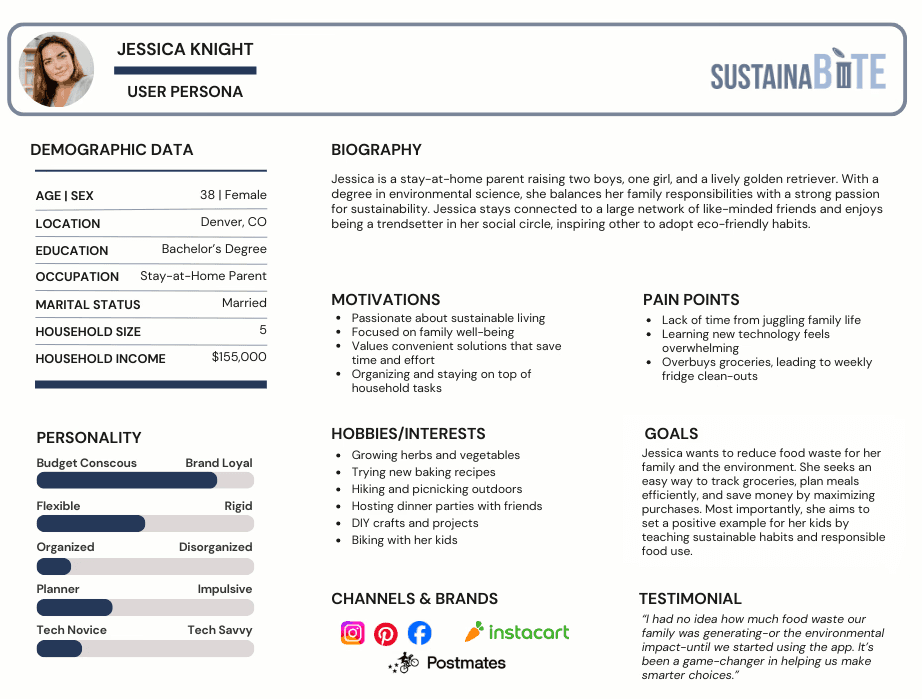
persona: jessica knight (38, stay-at-home parent, Denver)
Motivated by sustainability and family responsibility, Jessica wants to reduce waste, stay organized, and model positive habits for her children, but struggles with time constraints, overbuying, and tech overwhelm.
journey map: mitchell clark (20, college student, Chicago)
Budget-conscious and juggling school, work, and roommates, Mitchell needs simple ways to avoid duplicate purchases and stretch every dollar with minimal effort.
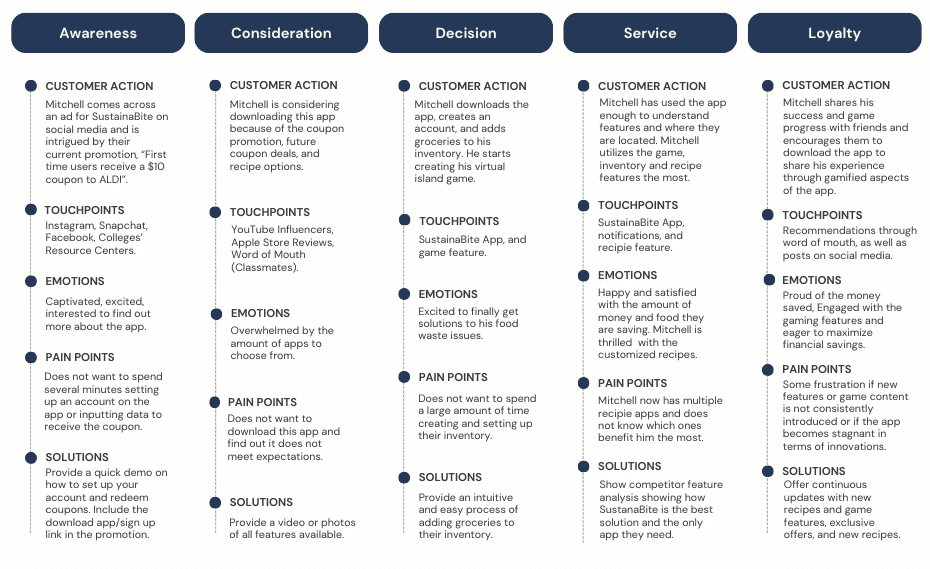
While their contexts differed, their journey maps revealed shared friction points (forgotten food, lack of visibility, and wasted money) paired with distinct motivators.
Designing for both meant creating a platform flexible enough to support family-scale coordination and individual efficiency without fragmenting the experience.
↦ the research
to understand how people manage groceries and waste in real life, we used a mixed-methods approach combining surveys, competitive analysis, and interviews with primary household shoppers.
Our research focused on:
Understanding everyday behaviors and barriers around food purchasing and storage
Evaluating perceived value of proposed features like inventory tracking, AI-driven recipes, and composting guidance
Identifying gaps in the sustainability app landscape where behavior change tools fall short
key insights that changed the product direction
Forgetfulness was a stronger driver than lack of care
Research revealed that most households rely on memory or visual checks rather than structured tools, leading directly to forgotten perishables and duplicate purchases. More specifically, forgetfulness (71%) and over-purchasing (17%) emerged as the dominant drivers of waste, particularly for short-lived items like produce and dairy.
Most participants already disliked wasting food. So, the real issue was not motivation. It was that food disappeared into the background until it was too late.


Users valued time and money more than abstract sustainability metrics
People were interested in sustainability, but what consistently mattered most were the practical benefits: saving money, avoiding duplicate purchases, and using what they already had.
More specifically, while participants expressed interest in sustainability, they prioritized tools that saved time and money over abstract environmental metrics.
Existing tools solved fragments of the problem
Recipe apps often ignored inventory. Budgeting tools lacked expiration context. Educational sustainability apps raised awareness without helping much in the moment. The system gap was not content - it was coordination.

Overdesign would have worked against the product
These insights led us to deprioritize social sharing and badge-based gamification, instead focusing on features that made waste visible, actionable, and personally valuable, reinforcing sustainability through everyday benefit rather than moral pressure.
The more I dug into user needs, the clearer it became that this product should not become a feature-heavy sustainability dashboard.
It needed to feel simple, useful, and easy to return to.
↦ the design decisions
the project got stronger once we stopped treating sustainability as the headline and started treating it as the byproduct of better defaults.
1. We prioritized practical utility over moral pressure
Rather than trying to motivate users with guilt or environmental shame, we focused the product around immediate value: visibility, reminders, recipes, and savings.
Trade-off: Less overt sustainability branding, but much stronger day-to-day relevance.
2. We deprioritized social features and heavy gamification
Research did not support building around leaderboards, public sharing, or badge-heavy systems disconnected from real household needs.
Trade-off: Fewer novelty hooks, but a clearer and more grounded product proposition.
3. We designed around the food lifecycle, not isolated tasks
Instead of solving just recipe discovery or just budgeting, we aimed to support the chain from inventory awareness to expiration action to meal decisions.
Trade-off: Broader product scope, but a more realistic fit for how waste actually happens.
4. We made savings the primary motivation loop
Financial visibility was much more motivating to users than abstract sustainability impact, so we treated savings as the strongest reinforcement mechanism.
Trade-off: Sustainability became less visually foregrounded, but more likely to stick behaviorally.
5. We kept the product structure intentionally lightweight
The app needed to fit into busy households, not become another system users had to manage constantly. That meant streamlining core flows and resisting the urge to add complexity for the sake of completeness.
Trade-off: Fewer features on paper, but a much stronger chance of repeat use.
↦ the refinement
one of the biggest lessons in this project was realizing that “more motivation” did not automatically mean “more gamification.”
Early testing showed that users understood the product and found the flows intuitive, but sustaining engagement over time was still a real question. The easy reaction would have been to pile on badges, social comparison, or extra dashboards.
But that would have pushed the concept in the wrong direction.
The more honest answer was that motivation had to come from actual usefulness. If the product helped users save money, remember what they had, and make easier meal decisions, that would do more for long-term engagement than novelty features ever could.
That realization helped clarify what not to build just as much as what to build.
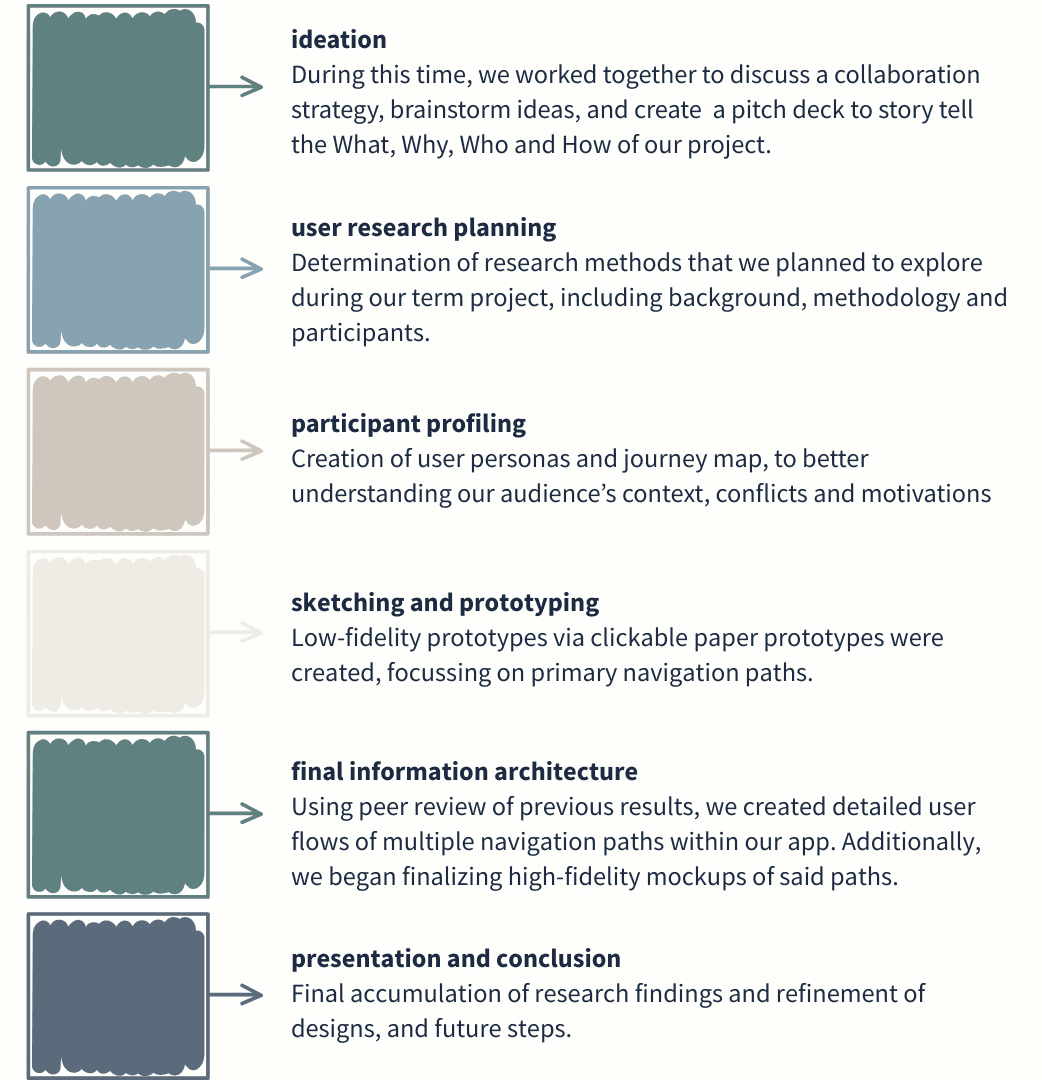
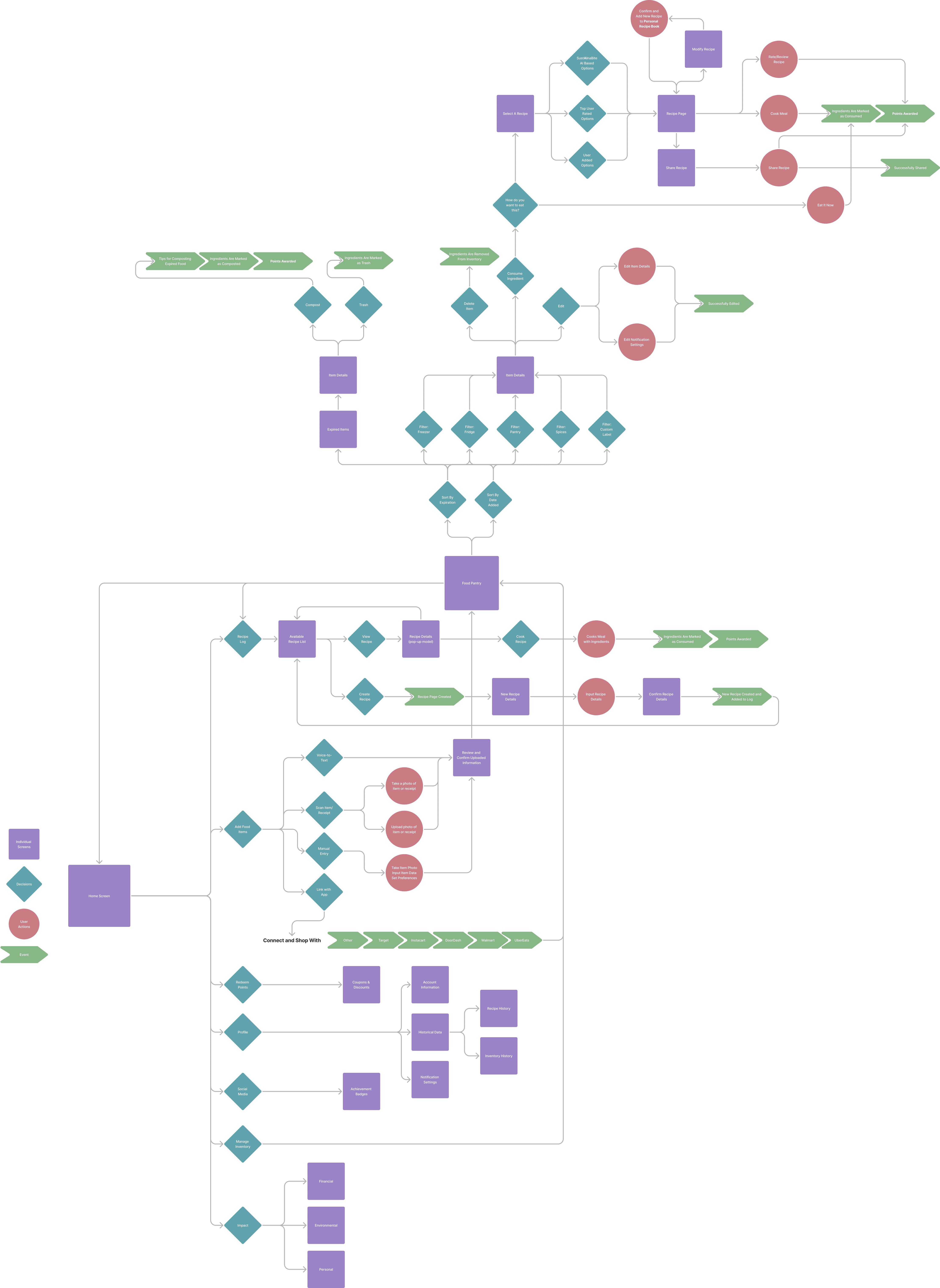
To translate insights into a coherent experience, we developed a detailed user flow mapping every interaction from app entry to task completion.
Purposeful Pathways: Flows clarified how each interaction supported waste reduction
Golden Path: Centered on adding inventory, finding recipes, and acting before food expired
Visualization: Flowcharts ensured navigation remained intuitive and human-centered
These flows helped align the team around a shared understanding of what mattered most, and what could be deprioritized.
↦ the solution
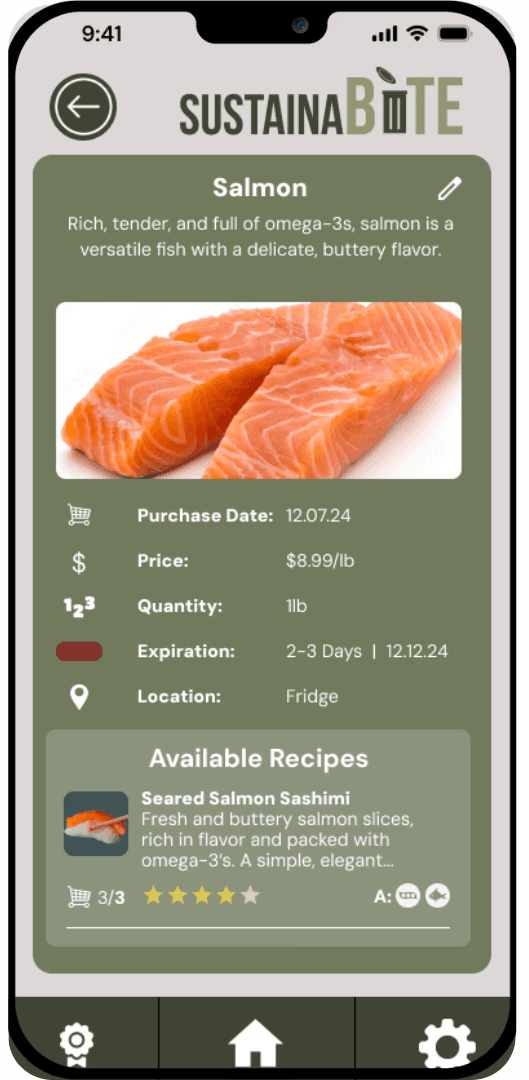
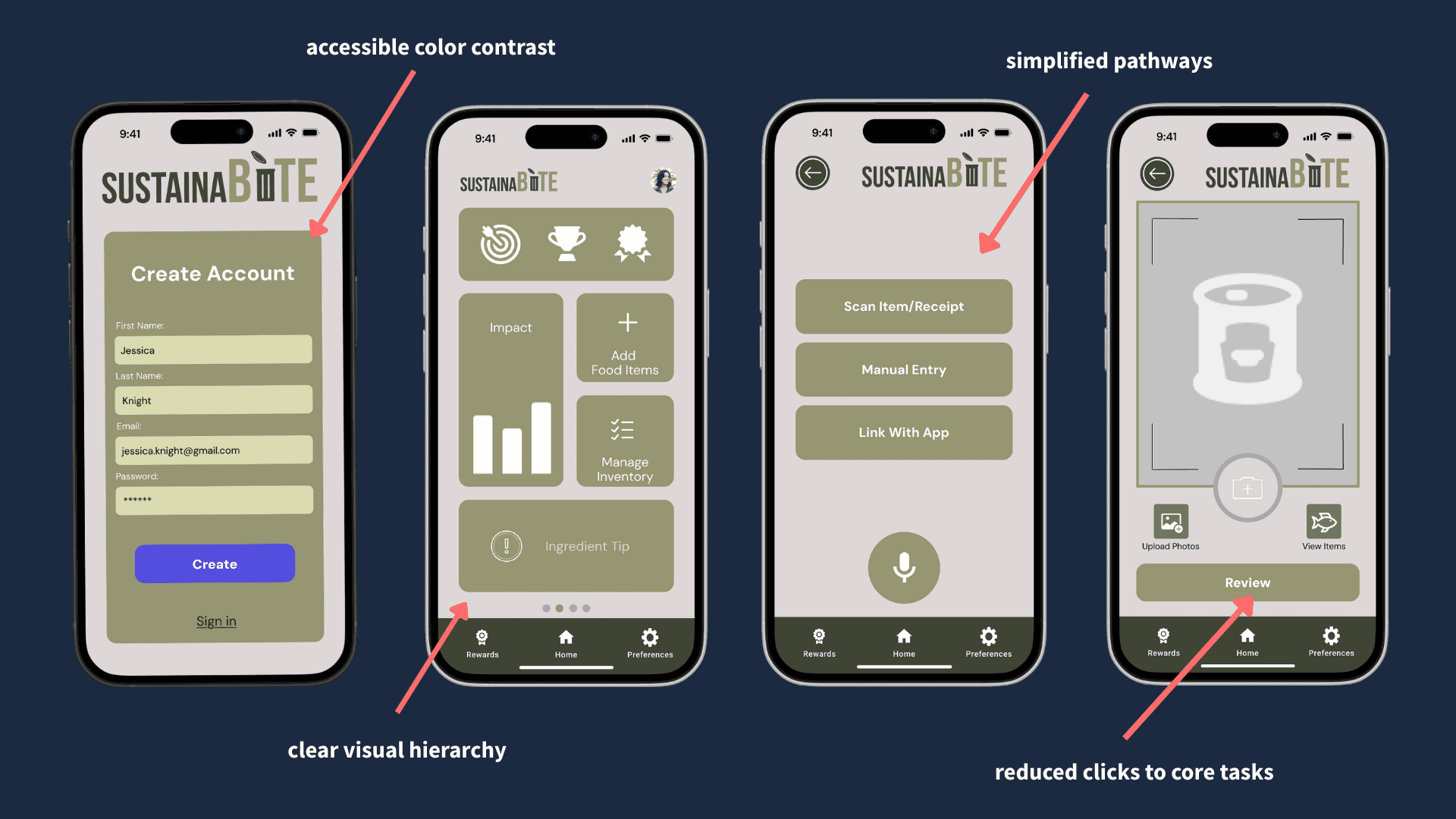
We designed SustainaBite as a mobile concept that helps households reduce waste by making food more visible, more actionable, and more relevant to everyday decisions.
The final direction focused on four core outcomes: inventory visibility, expiration awareness, ingredient-driven planning, and savings reinforcement.
Inventory visibility and expiration awareness
The system helps users keep track of food through receipt scanning, barcode entry, or manual input, reducing reliance on memory alone.
Once items are added, the app surfaces expiration timelines and reminders so food becomes visible before it becomes waste.
What this improves
reduces forgotten perishables
helps prevent duplicate purchases
supports faster, more informed grocery decisions
Ingredient-driven meal decisions
Rather than treating recipes as aspirational content, SustainaBite uses the ingredients users already have to surface meal ideas they can actually act on.
This shifts meal planning from “what sounds nice?” to “what can I make before this goes bad?”
What this improves
makes inventory feel useful instead of static
reduces unnecessary grocery purchases
supports practical action before food expires
Savings as a motivation loop
One of the clearest research findings was that money mattered. So instead of centering environmental statistics, I used savings as the main reinforcement mechanism.
The app surfaces the financial impact of using food before it goes to waste, making the payoff immediate and personal.
What this improves
gives users a tangible reason to return
reinforces behavior through everyday benefit
makes sustainability feel grounded rather than abstract
Lightweight sustainability education
Sustainability content still mattered, but it worked best when embedded contextually rather than presented as a separate educational layer.
That meant surfacing storage tips, composting suggestions, or waste-reduction guidance only when relevant to the task at hand.
What this improves
supports learning without interrupting flow
keeps the experience focused on action
makes sustainability feel integrated, not preachy
↦ the iteration and validation
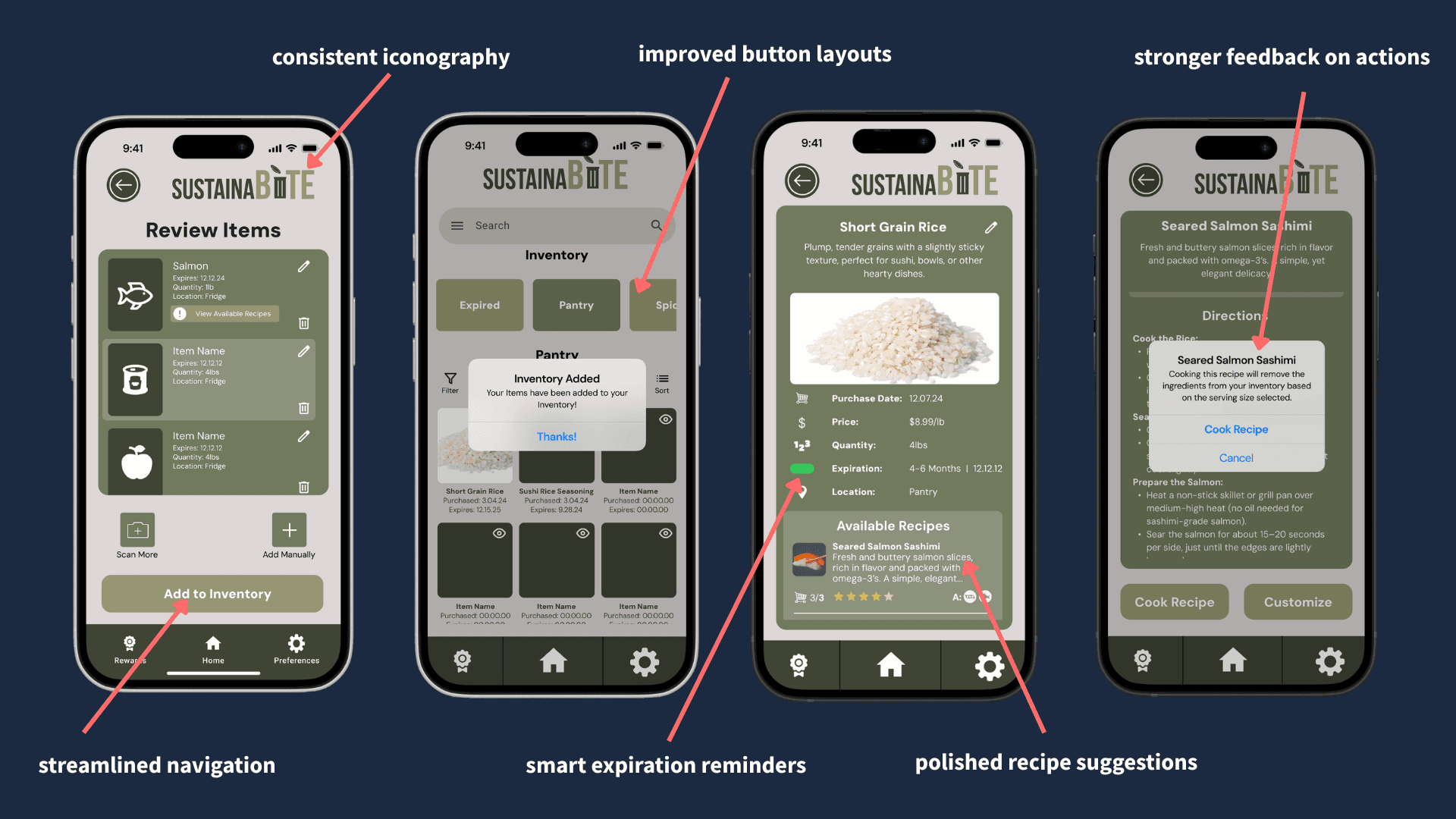
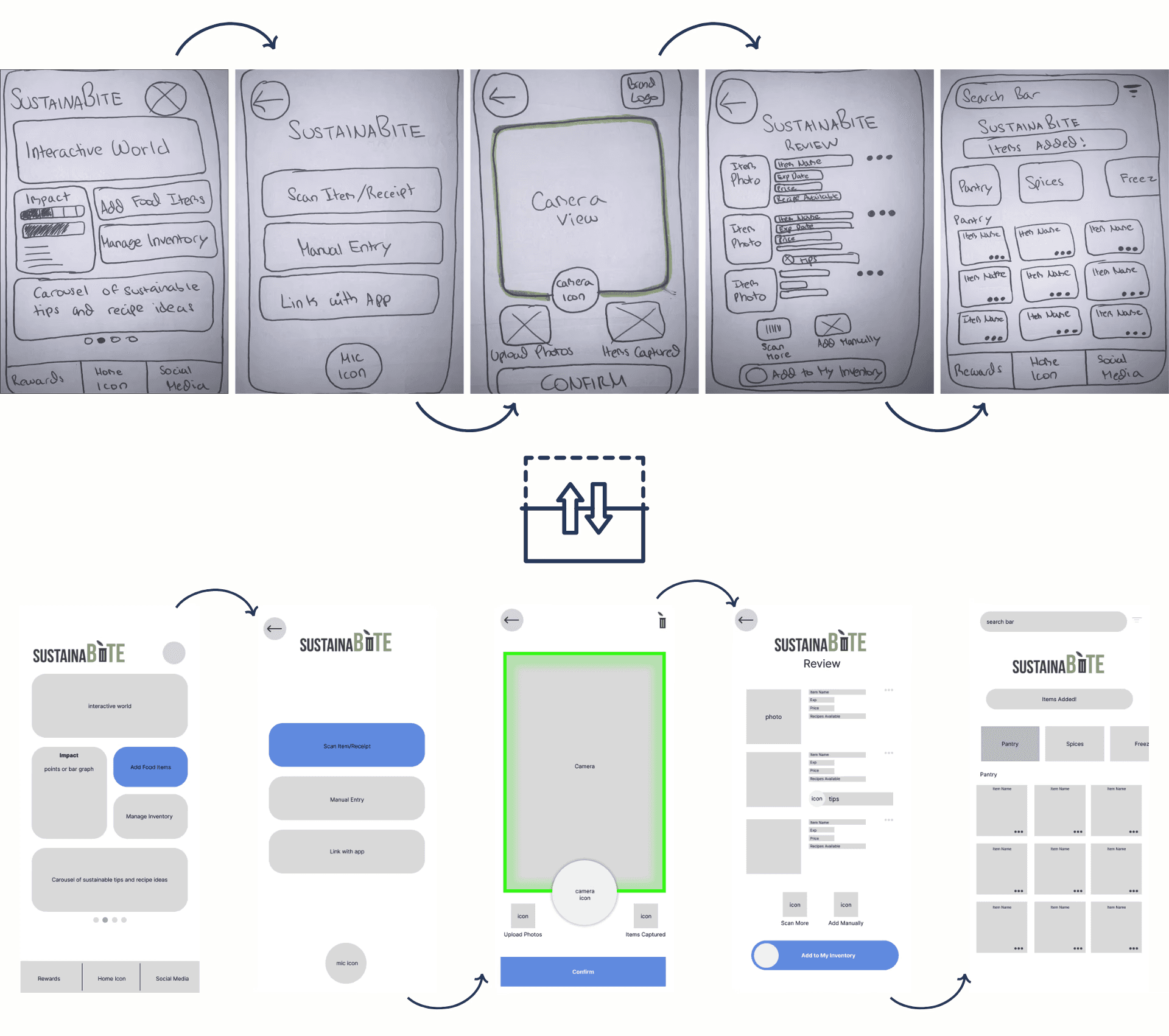
The design process started with paper sketches and low-fidelity wireframes focused on the product’s golden path: adding items, tracking expiration dates, and finding recipes.
Usability testing confirmed that these flows were clear and intuitive, which gave the team confidence in the product structure early on.
From there, iteration focused on:
streamlining navigation
improving visual hierarchy
clarifying reminders and inventory access
reinforcing the savings tracker as the primary motivation loop
The shift from low-fidelity to high-fidelity was not just visual polish. It made the product feel more immediate, more organized, and more obviously useful.
↦ the impact
SustainaBite reframed food waste as a systems problem rather than a motivation problem, which led to a more grounded and useful product concept.
Even without launch metrics, the impact of the work became clear in a few important ways.
For users
made food waste easier to see before it happened
reduced reliance on memory for inventory and expiration tracking
connected sustainability to practical value through savings and meal utility
For the product direction
translated behavioral research directly into prioritization decisions
clarified which features supported real everyday use and which ones added noise
positioned sustainability as an outcome of better routines rather than moral pressure
Through testing and iteration
validated the core structure of the product’s golden path
identified long-term engagement as a design challenge
strengthened the concept by removing unnecessary complexity and focusing on everyday relevance
↦ the reflection
This project taught me that a lot of sustainable behavior design fails because it asks users to be better instead of making the system better.
The more I researched household food waste, the more obvious it became that people were already trying. They were just doing it inside routines shaped by forgetfulness, time pressure, and limited visibility. Designing for that reality required less idealism and more honesty.
It also taught me the value of restraint. It would have been easy to make the app more feature-rich, more educational, or more performatively sustainable. But the stronger direction was quieter: build something genuinely useful, and let sustainability emerge from that.
If I continued the project, I would focus next on:
reducing manual input through grocery and retailer integrations
testing reminder timing and motivation loops over longer periods
exploring coupon or reward partnerships tied to waste reduction
expanding how households coordinate shared inventory across multiple people
More than anything, SustainaBite became a reminder that behavior change works best when it feels less like pressure and more like relief.

NEXT WORK
healing patient & planet (hp&p)
a research-driven redesign of hospital food systems that restores patient dignity, reduces caregiver burden, and transforms sustainability into measurable care outcomes.

