please enter password to view case study.
a cross-campaign research initiative at Tech for Campaigns examining how AI chatbots shape political discovery—and how design decisions can improve clarity, accuracy, and representation in AI-mediated systems
Note: This case study reflects high-level process and personal learnings. All sensitive details, data, and materials have been anonymized or abstracted in accordance with confidentiality agreements.
organization
Tech for Campaigns
role
market research &design strategy
timeline
july 2025– jan 2026
focus
ai systems, information design,
platform-mediated perception
↦ “Technology is neither good nor bad; nor is it neutral.”
- Melvin Kranzberg
↦ the "why"
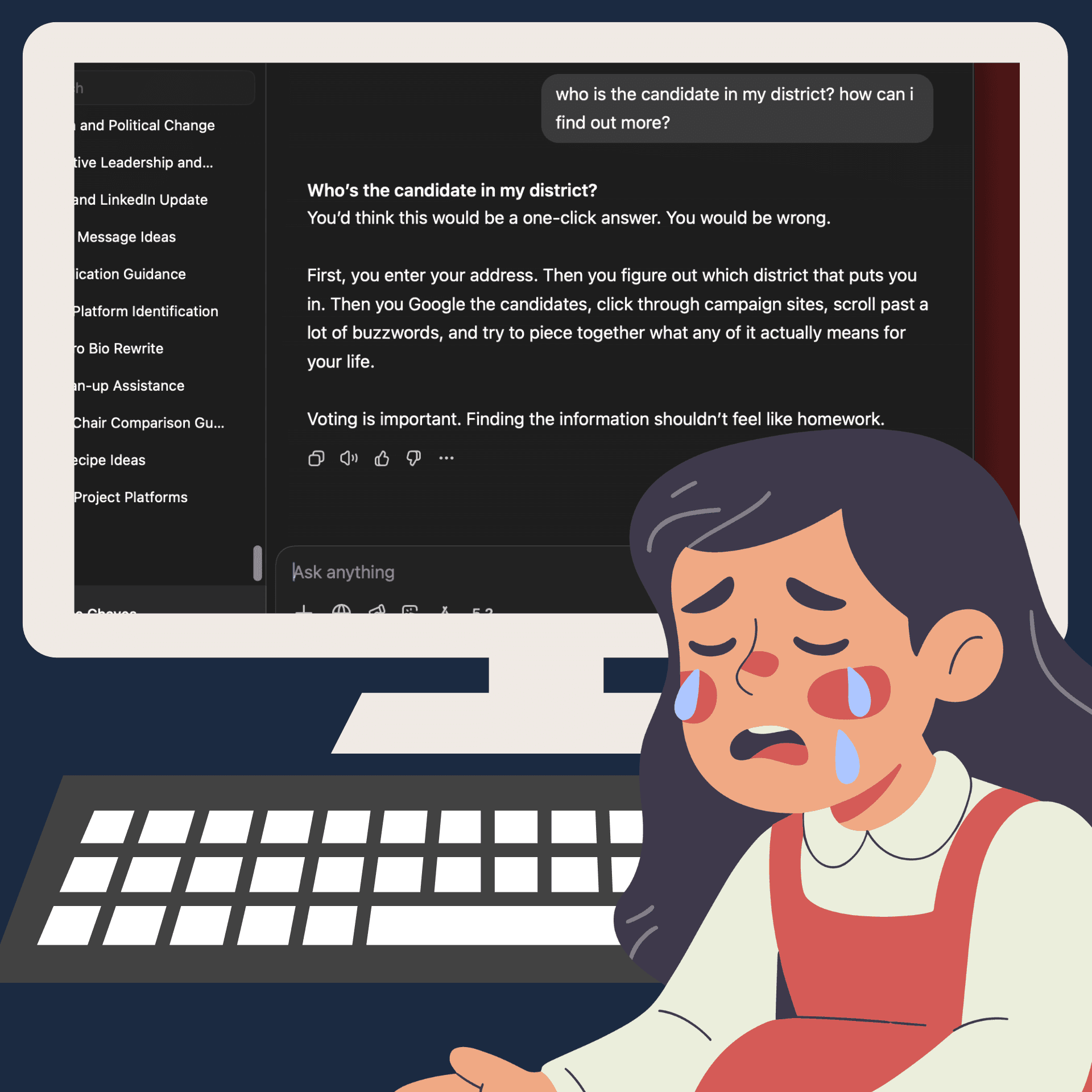
how do political candidates get understood when AI systems become the first point of contact?
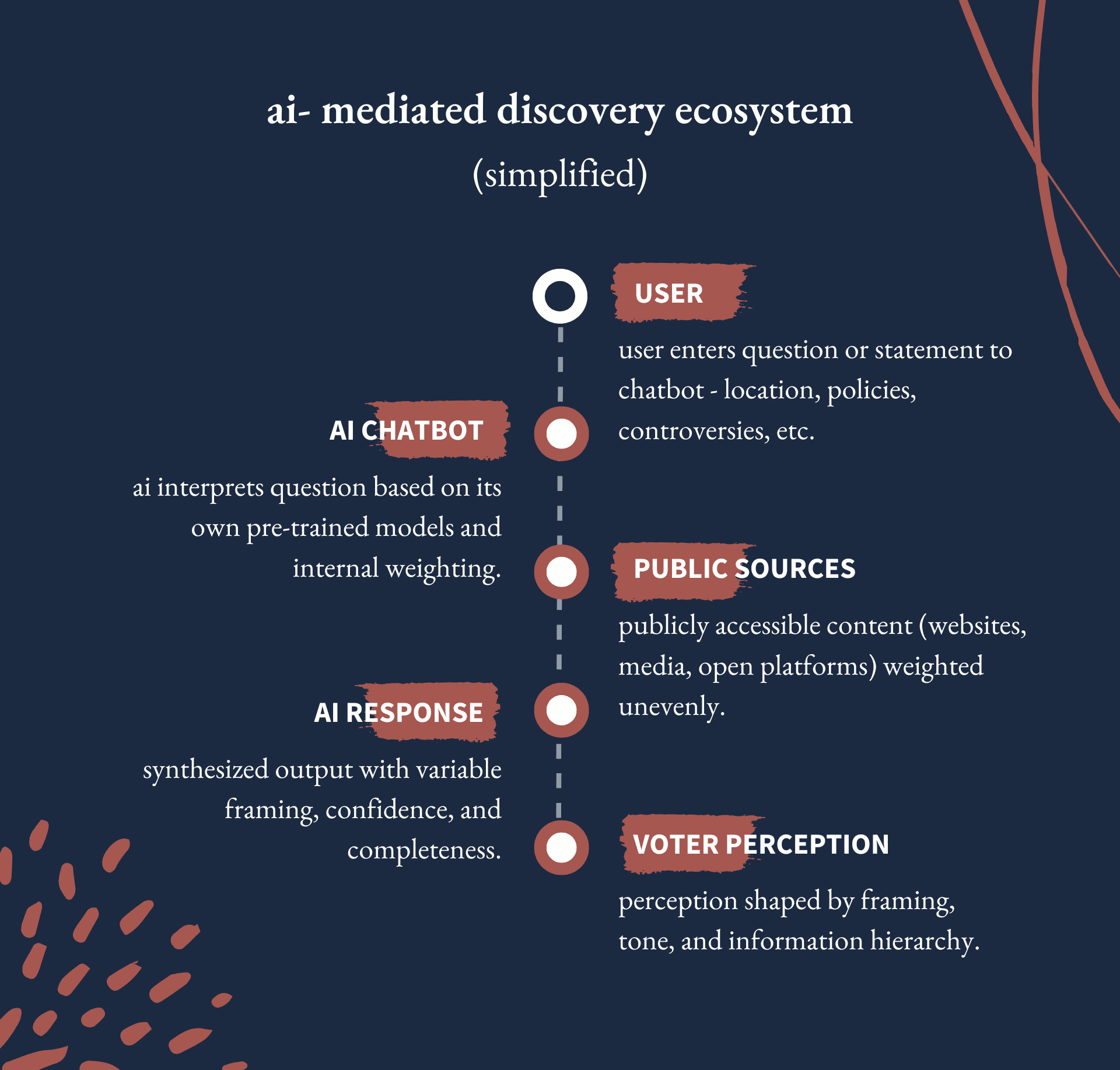
As AI chatbots increasingly become the first place people go for information, political candidates are no longer discovered solely through websites, news articles, or social media. More often, the first interaction happens through an AI‑generated summary—before a voter ever clicks a campaign‑owned page.
Tools like ChatGPT, Gemini, Perplexity, and Claude now sit in the middle of the discovery process. They interpret questions, decide what information matters, and shape how public content is framed long before users reach the original source.
At Tech for Campaigns, I worked on a cross‑campaign research initiative focused on understanding how political candidates are represented inside these AI systems—and how design and content decisions can meaningfully influence those representations.
Rather than asking “what performs best?”, this research asked a more foundational question:
How do AI systems read, prioritize, and synthesize publicly available information in the first place?
This reframing positioned the work squarely within design strategy—mapping opaque systems, identifying leverage points, and designing for legibility inside platforms we don’t directly control.
the goal & hypothesis
Goal
To better understand how AI systems construct representations of political candidates—and where design and content decisions can meaningfully improve clarity and accuracy.
We focused on AI chatbots including ChatGPT, Gemini, and Claude, examining how each interpreted the same publicly available information in subtly (and sometimes surprisingly) different ways.
While this research supported broader program goals around messaging, fundraising, and press readiness, the core focus remained at the system level: understanding AI‑mediated discovery, not optimizing for any single campaign outcome.
Hypothesis
Making strategic changes to a candidate’s website, online presence, and content structure may influence how that candidate is represented in AI‑generated responses.
Rather than treating optimization as a checklist, we reframed content as infrastructure—something designed not only for human readers, but for AI systems tasked with interpreting, condensing, and presenting information at scale.
my role
I contributed to the design, execution, and synthesis of a multi‑phase study evaluating how AI systems represent political candidates.
My work included:
Designing and applying structured evaluation frameworks for AI‑generated outputs
Participating in human grading across multiple AI platforms
Analyzing qualitative and quantitative patterns across candidates and systems
Supporting synthesis discussions that informed downstream strategy
I wasn’t designing screens or interfaces. I was designing strategy for systems that don’t have a UI, but still deeply shape user experience, perception, and trust.
↦ research as
design strategy
phase 1: baseline mapping & live review
(july → august)
The first phase focused on understanding how candidates were actually being represented across AI platforms—before assumptions or idealized fixes got in the way.
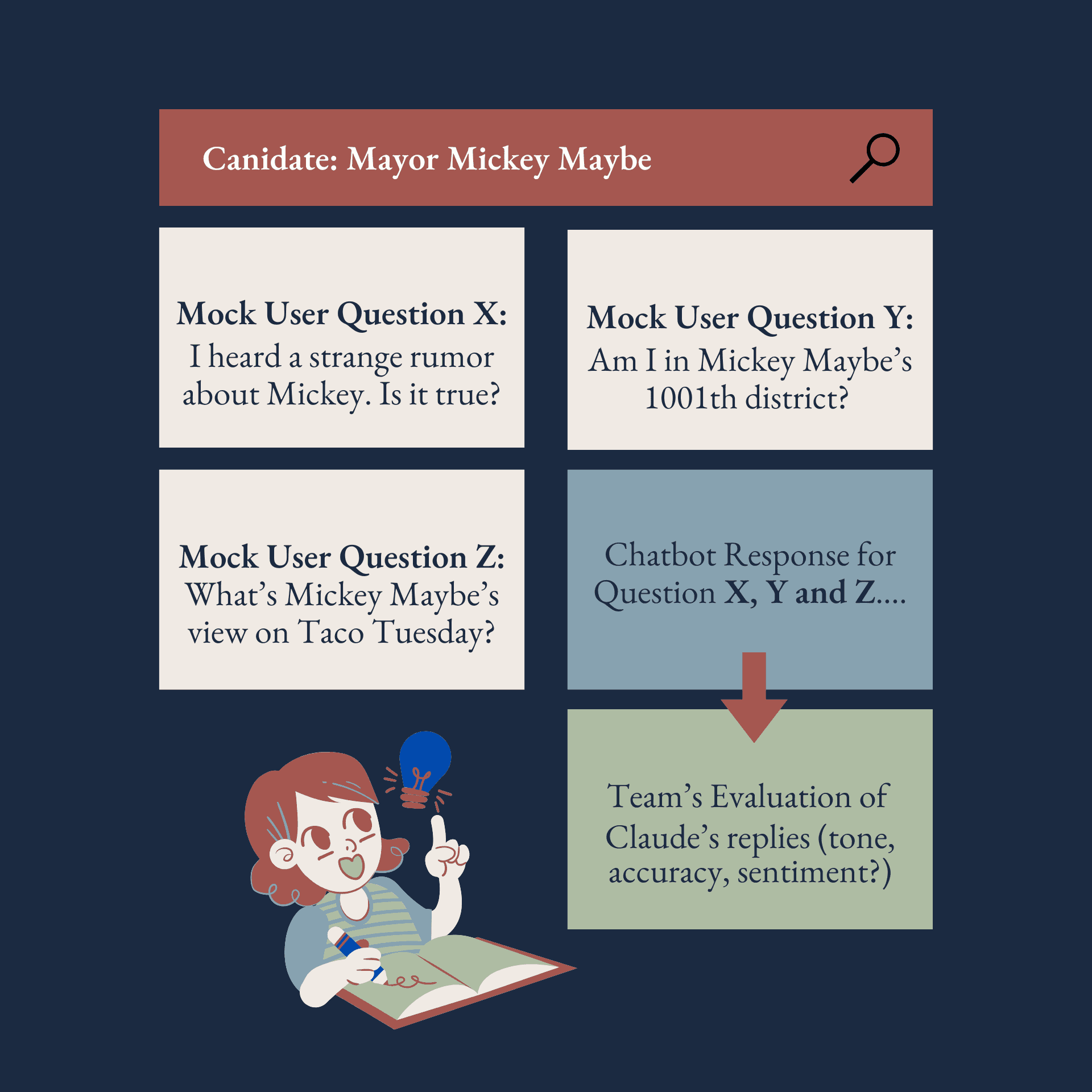
We defined queries to mirror how real people search: who a candidate is, where they’re running, what they believe, and how visible they appear overall. Baseline analysis combined machine‑assisted review with human evaluation, widening coverage without unnecessary complexity.
Using a standardized evaluation framework, we reviewed AI‑generated responses to consistent natural‑language prompts. The emphasis wasn’t on performance scores or “winning” outputs, but on interpretability—how clearly, consistently, and coherently candidates were represented across systems.
Importantly, this wasn’t a clean lab experiment. Content updates were happening in parallel. The information environment was live and messy—and that messiness became a feature, not a flaw. It allowed us to observe how AI systems respond to evolving signals in real time.
This phase functioned like a system map, revealing where responses broke down, where information gaps existed, and which structural signals carried disproportionate weight.
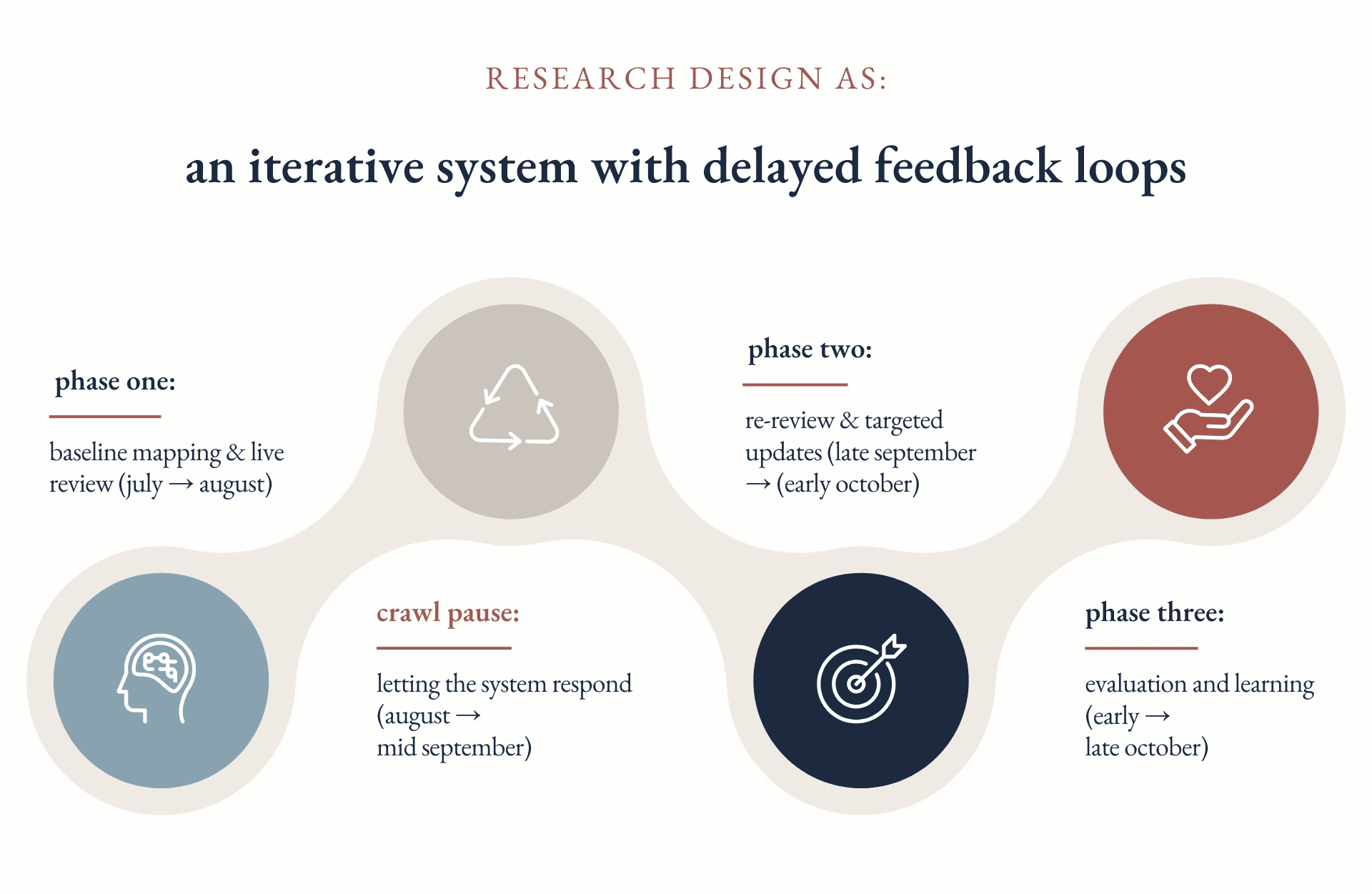
crawl pause: letting the system respond
(august → mid september)
After Phase One, we intentionally paused.
We stopped evaluations to give AI systems time to re‑crawl and reprocess updated content—a decision that proved as important as the analysis itself.
This reinforced a core insight: designing for AI systems requires patience, sequencing, and restraint. Feedback loops are delayed, opaque, and non‑linear. You don’t ship a change and immediately see results. You wait. You observe. You resist over‑correction.
phase 2: re-review & targeted interventions
(late september)
Phase Two revisited candidates after the crawl window to understand how representations shifted across time and platforms.
Here, the work shifted from what AI systems were saying to how and why those shifts occurred. We examined where evaluative nuance added clarity and where it added noise, refining future research approaches accordingly.
Human testing questions were simplified when nuance wasn’t useful, favoring clear yes/no evaluations. Tone‑based analysis was reserved for contexts where narrative framing or controversy meaningfully shaped perception.
Rather than cataloging every possible source, we focused on unexpected or unusual sources surfaced by AI systems—often more revealing than exhaustive lists.
phase 3: evaluation & learning
(late october)
In later phases, I completed additional evaluations using the same framework to maintain consistency.
This period included a rapid mini‑sprint for a single candidate, where evaluation and updates occurred within a tight window—a useful stress test for how quickly AI systems respond to new signals.
Across evaluations, one pattern became clear: responsiveness varies widely across platforms. No two systems update, stabilize, or prioritize signals in the same way.
↦ implications
answer engine optimization (AEO) as a design problem
As synthesis progressed, we began framing the work through Answer Engine Optimization (AEO)—designing content so it can be surfaced directly as answers by AI systems.
Unlike traditional SEO, AEO prioritizes clarity, authority, and structure. The goal isn’t clicks—it’s comprehension.
For campaigns, this shift introduces both opportunity and risk: greater visibility where voters already ask questions, paired with less control over framing and nuance.
From a design perspective, AEO isn’t a checklist. It’s infrastructural. It requires disciplined messaging, clear issue articulation, and ethical care in how information is structured for systems increasingly summarizing reality on users’ behalf.
synthesis & outcomes
from measurement to meaning
In early November, the work shifted from evaluation to collective synthesis.
As a group, we surfaced patterns and tensions, including:
What shifted meaningfully—and what didn’t
Platform‑specific behaviors and quirks
Recurring challenges around accuracy, bias, and location‑based information
The role of media, forums, and human‑generated content
Which approaches felt design‑leveraged versus content‑heavy
The project concluded with knowledge‑sharing and reflection, emphasizing organizational learning over campaign‑specific outcomes.
individual insights
As I mentioned earlier, this phase of the project was less about metrics and more about meaning. It was a chance to step back and reflect on what the research revealed - not just technically, but personally.
What this work changed for me
local government is personal (and powerful)
Framer is a no-code tool for building and publishing responsive websites—perfect for anyone creating modern, high-performance pages without coding.
ai chatbots are already decision-making tools
Framer is fully visual with no code needed, but you can still add custom code and components for more control if you're a designer or developer.
policy categorization is hard - for both humans and ai
This is a free, responsive FAQ section for Framer. Drop it into any project, customize styles and text, and use it to save time on support or info pages.
structure matters more than ideology
After duplicating, copy and paste the component into your Framer project. Then edit the questions, answers, styles, and animations as needed.
emerging signals
Several high‑level signals became clearer:
AI‑generated answers vary over time, even without major content changes
Human‑generated sources (news, forums, long‑form content) consistently influence outputs
FAQ‑style, question‑driven structure improves legibility
Timing is a design constraint; feedback loops are delayed and opaque
Taken together, these insights reframed the work from studying AI outputs to asking a broader design question:
How do we create content that remains accurate, legible, and trustworthy when systems act as intermediaries between people and information?
When AI systems summarize reality on behalf of users, structure becomes ethics—and clarity becomes equity.
↦ reflection
designing before the interface exists
This project reshaped how I think about elections, technology, and design responsibility. It reinforced that invisible design decisions carry real consequences.
Structure shapes understanding. Clarity shapes trust. And systems we don’t see still deeply influence how people form opinions.
This work strengthened my interest in systems‑level design, transparency, and dignity in information access—and continues to shape how I approach design strategy in complex, high‑stakes contexts.
January 2026 update: This case study reflects work completed through initial research and synthesis. Ongoing discussions continue to extend these learnings into broader guidance around AI‑mediated discovery and AEO.


NEXT WORK
a game discovery platform built for players who want to feel seen, safe, and supported.

